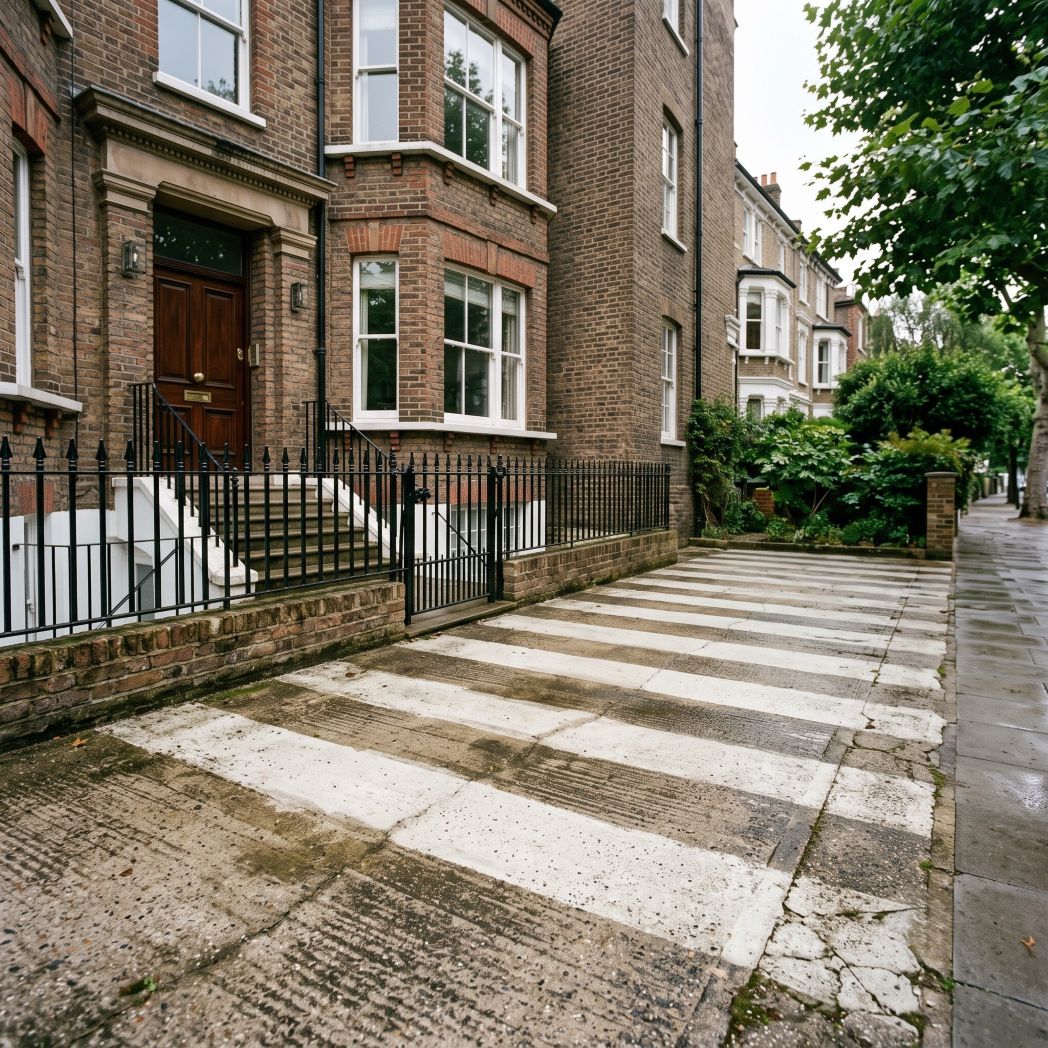
The first job I ever had to go back and redo was a parking apron behind Green Lanes in Harringay. Forty-odd square metres of twenty-year-old concrete, four hours with a lance, and I walked away thinking I’d done a decent job because the slab was wet and wet slabs all look fine. The owner rang me at nine the next morning. By then it had dried out and it was striped like a deckchair – light bands about 300mm wide running the length of the apron, dark bands between them, dead straight, plain as day from the pavement.
I’d cleaned it in ribbons and gone home. That’s all zebra striping is: an honest record of where the water went and where it didn’t, written on a surface that holds the record for years.
The awkward part is that half of it can be fixed by doing the job again properly, and the other half means the concrete is now permanently two different concretes.
What are you looking at when a slab comes up striped?
Two completely different defects share the same name, and telling them apart decides whether you’re booking half a day or having an expensive conversation.
The first is soiling contrast. The light bands are clean concrete and the dark bands are dirt you missed – the fan pattern of a lance carries most of its energy down the middle and tails off at the edges, so an operator walking a wand in overlapping lines removes maybe 90% of the grime under the centreline and 40% under the feathered edge. Wet, it all looks uniform. Dry, the difference is a barcode.
The second is etch contrast. Here the light bands are missing cement paste. The jet has taken the fine surface layer off in strips and exposed the sand and finer aggregate underneath, which is paler and rougher and has a different porosity to the untouched bands. That’s topography rather than dirt, and no amount of re-cleaning brings it level, because the only way to make the dark bands match the light ones is to remove the same depth of paste from those too.
There’s a third pattern that pretends to be striping and isn’t either of the above. Hard water rinse marks – broad, soft-edged pale bands that follow the run-off rather than your passes, showing up only after a hot afternoon. Mains water in most of Greater London is hard enough to leave a calcium film when it evaporates off a warm slab, and if you finish a drive at two on a July afternoon and let it dry in the sun, the last water to leave deposits its minerals in the low spots. It brushes off. It also tells you that you rinsed a hot slab, and that a slab that dries while you’re still cleaning it will stripe from the chemical too.
The two-minute test
Wet the whole slab and watch it dry. Soiling stripes fade under the water and come back, plain as day, as the last of the moisture leaves. Etch stripes do the opposite – the light bands dry first and stay light, because the exposed sand has more open pore structure and releases water faster than the sealed, burnished bands beside it. Do this before you quote a rectification, not after.
Why does a lance stripe when a surface cleaner doesn’t?
Geometry and human beings.
A 25-degree fan at 250mm covers about a 100mm band, and the energy across that band is a bell curve. To get an even clean you need each pass to overlap the last by half, so the weak edge of one pass is covered by the strong middle of the next. Nobody does this for four hours. You overlap at 50% for the first ten minutes, then it drifts to 30%, then you’re tired and it’s 15% and you’re sweeping the wand in an arc instead of walking it in a line, which puts the tip 200mm from the slab in the middle of the swing and 400mm at the ends.
A surface cleaner solves all of that mechanically. Two or three jets on a rotating bar under a skirt, standoff distance fixed by the housing, dwell time on any point set by the rotation rather than by whoever’s holding it. The machine doesn’t get bored at three o’clock.
The overlap rule and why nobody keeps it
Overlap is unpaid work. That’s the whole reason it collapses. Cleaning at 50% overlap means covering every square metre twice, so a slab that measures 60m² comes to 120m² of lance travel, and if the job was priced as a four-hour visit the overlap is the first thing to go. Zebra striping is a pricing defect that shows up as a technical one. I’d say most of the striped driveways in Greater London were striped by a man who quoted in good faith for the wrong number of hours and then made the numbers work in the only place he could.
Can a surface cleaner stripe too?
It can, and when it does the pattern gives the cause away.
Even, closely spaced bands perpendicular to your walk – a fine corduroy, maybe 40 to 60mm apart – means you walked too fast for the bar speed. Each jet traces a cycloid across the concrete and if you outrun the rotation, the traces stop overlapping and you get clean arcs with dirty gaps between. Slow down or turn the pressure down and slow down anyway.
Wide, irregular curved bands mean the skirt or the wheels are the problem. A worn castor drops one side of the housing and now the bar is closer to the slab on that edge – stripes on one side only, following your path around the slab like a signature.
Chatter marks, that stippled look, come from a bar that’s spinning too fast for the flow it’s getting. Undersized or kinked hose, or an inlet filter half full of grit off the last job.
One nozzle blocked is the whole slab
Worth saying on its own. A surface cleaner with one of its two jets partly blocked will clean at exactly half the intended coverage and it will look like it’s working, because the bar still spins and water still comes out. You find out when it dries. Check the tips before you start and again after lunch. Ten seconds against four hours.
How much of the striping was in the slab before you got there?
More than contractors admit and less than clients hope.
Concrete is poured in bays and finished by hand, and a power float leaves burnish variation across a slab that nobody sees while it’s grubby. Take the dirt off evenly and those bands appear – lighter where the float worked the paste harder, darker where it didn’t. That’s the slab’s own history coming up, and it isn’t your fault, but it’s your problem, because you’re the one who was standing there when it appeared.
Curing compound is the other one. Wax and resin-based compounds get sprayed on fresh concrete to hold moisture in, and they wear off unevenly over years – heavier under the parts of a drive nobody drives on. A degreaser strips the remaining compound where it’s thin and leaves it where it’s thick, and you’ve got stripes that follow the wheel tracks of a car that was sold in 2009.
Ask the awkward question at the quote
I walk a slab wet before I price anything now, all of it, every corner, and I say out loud what’s likely to show. Half the time the client already knows the drive is patchy and would rather it stayed grey and filthy than be clean and mottled. Plain as day is not always what people want. That conversation costs nothing at the quote stage and costs a rectification visit after.
Can zebra striping be fixed once it’s there?
Soiling stripes, yes. Re-wash the whole area – the whole area, not the dark bands, because spot-cleaning stripes gives you stripes at a different pitch – with a surface cleaner and a proper degreaser dwell, at a walking pace slow enough to feel silly. It comes level.
Etch stripes are a different bill. You’re choosing between three unhappy things: level the whole slab down to the depth of the deepest damage with a very even mechanical process and accept a paler, rougher drive; resurface with a micro-topping or a bonded overlay; or leave it and let three or four winters of dirt blur the difference, which they mostly do.
Half the trade will tell you a sealer hides it. A sealer makes it worse – it saturates the exposed sand darker than the burnished bands and you get your stripes back in reverse, in gloss.
Timing the rescue
The one thing in your favour is that concrete is a slow surface. An etched slab looks worst in month one and better every month after, because the exposed sand takes dirt faster than the burnished paste and the two tones creep towards each other. A drive I striped badly on a rushed job near Nine Elms was unbearable in June and unremarkable by the second spring. That’s a real answer for a client who has been quoted four figures for an overlay – do nothing for two years, then look again. Very few contractors will say it, because there’s no invoice at the end of it, and it’s the correct advice for maybe a third of the striped slabs I get called to.
What you must never do in the meantime is chase it. Every attempt to blend the dark bands takes more paste off and deepens the contrast, and I’ve seen a slab in a yard off Rainham Road worked over three times by an increasingly desperate operator until the surface was more sand than concrete and the whole thing had to come up.
Any contractor who turns up to clean sixty square metres of flat concrete with a lance and no surface cleaner should be sent home before he unrolls the hose. He isn’t going to clean your slab. He’s going to draw on it.
The apron in Harringay took me a second Saturday with a borrowed 20-inch surface cleaner and it came up even. I didn’t charge for the return visit and I’ve owned a surface cleaner ever since.