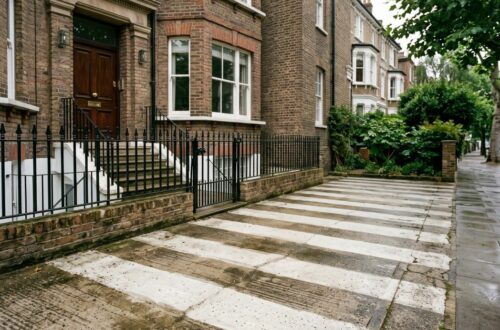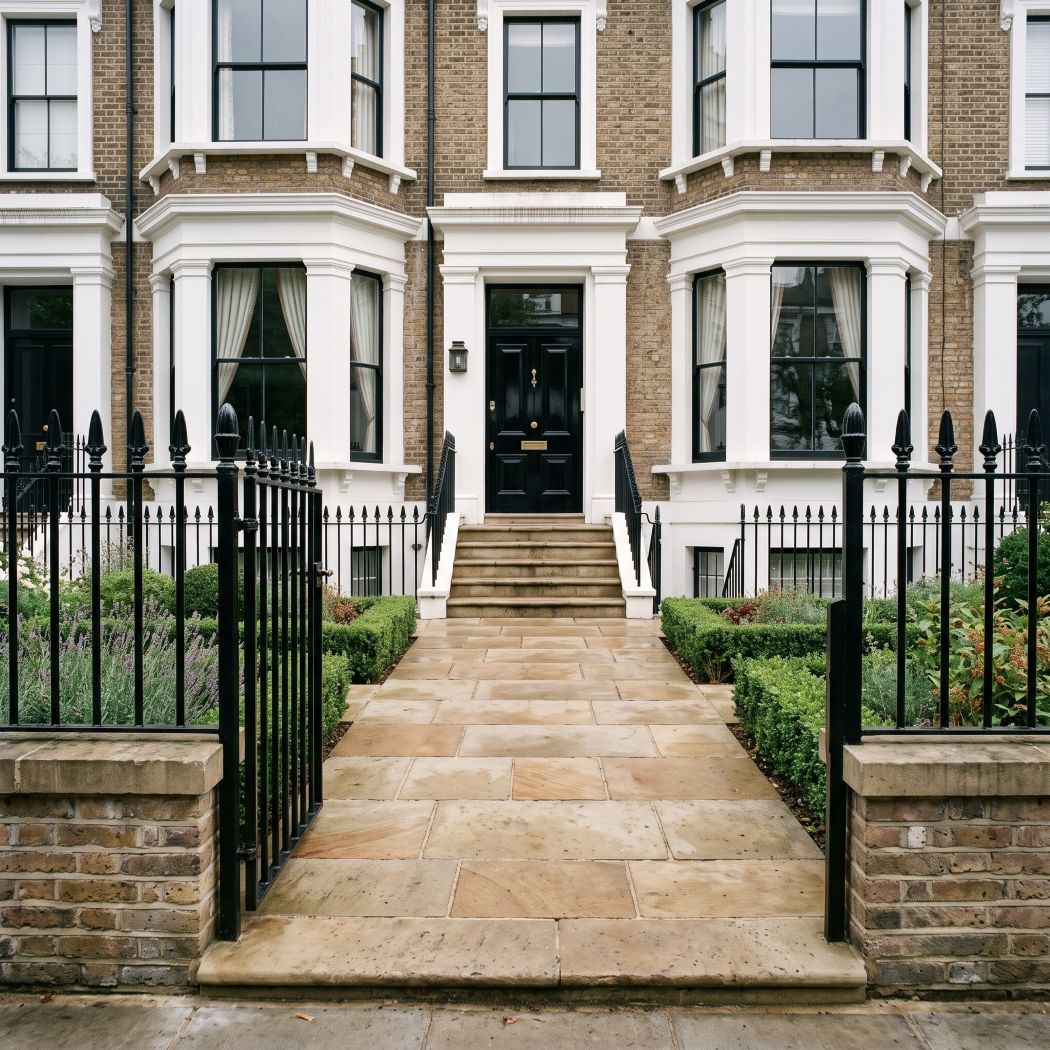
A woman on Downshire Hill in Hampstead once asked me to make her front path look new. It was original York stone, laid some time in the 1870s, five big riven flags running from the gate to the step, worn into a shallow dish in the middle where a century and a half of feet had gone in and out. The surface was dark, a bit green at the edges, and it had the faint diagonal ripple you get from a stone that was split rather than sawn.
I told her I could make it look new. It would take about ninety minutes with a 15-degree tip, and afterwards she would have five pale, evenly sugared slabs that would go green again by the following March, and the ripple would be gone. She looked at the path for a while and then asked what I’d do instead. That’s the only time a client has ever asked me that question first.
York stone is the one material in this trade where the cleaning does more damage than the dirt, and the damage is permanent in a way that almost nothing else on a London property is.
What is Victorian York stone actually made of, and why does that change the job?
Carboniferous sandstone, quarried around Elland and Crosland Hill and Bramley Fall, shipped south by canal and rail through the middle of the nineteenth century and dropped on half the footways and front paths in the capital. Under a hand lens it’s quartz grains – hard, chemically dull, effectively indestructible – held together by a matrix of clay minerals and iron compounds.
The grains will outlive everybody. The matrix is what fails, and it’s softer than the grains by a wide margin, and a pressure washer removes it preferentially, exactly the way water takes mortar out of a joint before it touches the brick. Once the matrix goes, the quartz grains have nothing holding them and they come away under a shoe. That’s sugaring, and the surface of a sugared flag will keep shedding for years. I’d sooner hand a client a bill for nothing than start that process on stone this old.
Case hardening – the skin you get exactly once
Here’s the part that almost nobody outside conservation work knows. Over decades, minerals migrate to the surface of a sandstone flag and deposit there as water evaporates, forming a case-hardened skin a millimetre or two thick that’s denser and tougher than the stone underneath. It’s why a 150-year-old flag can look weathered but stay sound.
Blast that skin off and you’ve exposed the raw, weaker interior – the bit that was never meant to face the weather – and the stone begins to decay at a rate it never would have otherwise. There’s no putting it back. Every “restoration” job where a York path came up bright and then fell apart over five winters is this mechanism, and the operator has almost always gone home pleased with himself.
Is the black on the flags dirt, or is it the stone?
Worth ten minutes of looking before anything is applied. I’d sooner spend that ten minutes than guess. Wet a corner with plain water. If the black lifts to a fingernail and the water runs grey, it’s soiling – a century of Camden coal smoke and diesel particulate – and it will come off with patience.
If it stays put and the wet stone shows a hard, glassy dark film, it’s a crust that has become chemically part of the surface. Removing that means removing stone. And if the black is confined to the hollows and the sheltered edges while the exposed high spots are clean, you’re looking at the natural weathering pattern of the flag, which is doing a decent job of protecting it.
The green is different and much less serious. Algae is a surface organism on a damp north-facing path and it comes off with a biocide and time. Moss in a joint is a maintenance issue. Neither one is eating your stone.
When leaving it alone is the right answer
Most Victorian York stone in London should not be cleaned. I’ll defend that against anybody. The soiling is not damage, and the desire to remove it is nearly always an aesthetic preference dressed up as maintenance – somebody wants their path to look like it arrived on a pallet from a merchant in Bicester last Tuesday. The tooling marks, the wear dish, the colour variation between flags out of three different beds – that’s the value of the thing, and it is not renewable. A modest wash to lift loose dirt and kill the algae, done every few years, keeps a path safe and honest. Anything more ambitious than that is somebody buying a newer stone at the price of an older one.
Which methods clean York stone without stripping it?
Low pressure, warm rather than hot, wide fan, held well back, with the chemistry doing the work and the water doing the rinsing. On domestic York I run 40 to 60 bar at the tip through a 40-degree nozzle at 300mm and I move constantly. The pressure figure matters less than the fact that I’m never trying to remove anything with the jet itself.
Chemistry: a pH-neutral or mildly alkaline stone cleaner, dwelling, agitated with a nylon brush. Then a DDAC or benzalkonium chloride biocide applied afterwards to dry stone, left to work over weeks rather than rinsed off in an hour. Sodium hypochlorite is quick and I keep it away from sandstone – it bleaches unevenly and it drives salts into a material that already has ferrous minerals looking for an excuse.
Water volume matters more than people expect, and it works both ways. A high-flow machine at low pressure floods the surface and carries the loosened dirt away without abrading anything, which is what you want. It also soaks the flag. A Victorian path is bedded on ash or sand over London clay with no membrane and no drainage to speak of, so everything you put on the top has to come back out through the top, bringing dissolved salts with it. Wash a path in November and you’ve charged the stone with water going into the first frost of the year, and the water that crystallises inside a pore expands by roughly nine per cent. I don’t wash old sandstone between October and March. Nobody’s path is so green that it can’t wait until April.
DOFF, TORC and whether any of it belongs on a front path
The conservation kit is real and it works. DOFF puts superheated water on the stone at around 150°C but only 2 to 3 bar, so the heat kills growth and softens soiling while the pressure never threatens the surface. TORC and the vortex systems swirl a fine inert granulate in low-pressure air and water, and in trained hands they take a soot crust off a listed façade without touching the tooling underneath.
On a Victorian terrace off Ladbroke Grove, that’s the right answer and the only answer. On a five-flag front path in a conservation area, an operator quoting conservation rates and turning up with a DOFF trailer is selling reassurance more than cleaning. Half of them have done a two-day course. The kit is only as gentle as the person holding the lance, and the lance is what decides.
Why is acid so much worse on York stone than on anything else?
Because of the iron. Sandstone carries ferrous minerals through the body of the stone – pyrite and iron-bearing clays – and acid mobilises them. Hydrochloric acid, brick acid, patio cleaner off the shelf at a builders’ merchant: any of it goes on grey York stone and comes back a fortnight later as a brown or orange bloom that rises from within the flag and can’t be washed off, because it’s rising out of the stone rather than sitting on it.
The bloom keeps developing for months. I’ve seen a path in Kennington go from clean grey to the colour of weak tea over one summer after somebody used a proprietary “stone reviver” that turned out to be 8% hydrochloric.
The cement problem, and the sealer problem
Two other ways to wreck this stone permanently. First, pointing Victorian flags in a strong OPC mortar – the stone needs a lime mortar softer than itself, so that movement and salt crystallisation happen in the joint rather than in the flag. Cement traps moisture at the arris and blows the edges off.
Second, sealing. Every year somebody suggests I seal a York path. A vapour-tight sealer on a stone that has to breathe out ground moisture will delaminate it from beneath, and the wet-look finish it gives is an insult to a 150-year-old flag. I’d sooner lose the work than put a tin of that on a path like the one on Downshire Hill.
So what does a sensible York stone clean actually look like?
Sweep it. Clear the joints by hand with a knife rather than a jet, because the jet takes the bedding sand out from under the flag and the flag rocks by August. Warm water, mild neutral cleaner, dwell, brush, rinse wide and back. Biocide afterwards, left alone. Repeat in three years.
What I won’t do on that list is as long as what I will. No turbo nozzle. No rotary surface cleaner, which will iron the riven texture flat and leave a corduroy of arcs across every flag. No acid of any strength, no matter what the label calls itself. No lifting flags to relay unless one is properly rocking, because a Victorian flag out of its bed rarely goes back the way it came and the bedding is part of the archaeology. And no wire brush, ever – the steel leaves particles in the pores that rust out weeks later and freckle the whole path orange.
The bit clients find hardest
It won’t look new. It will look like clean old stone, which is a slightly disappointing thing the first time you see it, because clean old stone is grey-brown and mottled, with the dish still worn into the middle.
She kept the path. It’s still there, still dished, faintly green on the north edge in February, and it’ll outlast the both of us.